- Call Us:- +91 7326070444 / +91 674 2913291
- Mon - Fri: 09.00AM to 06.00PM

Our Services

- Hydrogeological Investigations
- Hydrogeochemical Investigations
- Geophysical Investigations
- Groundwater Modelling
- Remote Sensing and GIS
- Managed Aquifer Recharge (MAR)
- Geochemical Indexing
- Human Health Risk Assessment
- Hydrological Investigations
- Sediment Transport Modelling
- Human and Climate Impact Studies
- Environmental Impact Assessment (EIA)
- Policy Design and Analysis
- Research Consultancy
- Need-based Training
Geochemical Characterization of Groundwater and Source Apportionment of Potential Pollutants in a Tribal Stretch infected with Chronic Kidney Disease of Unknown Etiology
Chronic kidney disease (CKD) has become the third fastest-growing health concern globally, currently affecting around 850 million people. By 2040, it is projected to become the fifth leading cause of years of life lost, with an estimated annual mortality of 2.2 to 4 million people. Among its various forms, Chronic Kidney Disease of Unknown Etiology (CKDu) is the most perplexing, with no clear consensus on its origin. The disease lacks globally standardized diagnostic criteria and does not present a consistent clinical profile. Even the global authority Kidney Disease: Improving Global Outcomes (KDIGO) has remained silent on its underlying causes.
What is common worldwide, however, is the demographic it primarily affects—low-income agricultural workers in economically vulnerable communities, particularly across low- and lower-middle-income countries in Africa, Asia, and South America. According to the World Bank, CKD imposes the highest economic burden among all disease categories, suggesting the profound financial and social impact of CKDu on affected families in these regions.
This study focuses on Supebeda, a tribal village in the Gariabandh district of Chhattisgarh state in central India, where more than 100 deaths and over 300 hospitalizations have occurred due to CKDu. The issue gained widespread attention in 2018 following intense media coverage and public outcry. As the entire community relies solely on groundwater for all domestic and agricultural needs, residents raised concerns about its potential contamination. Recent studies in other regions have also increasingly pointed to groundwater quality as a significant contributing factor in CKDu’s emergence.
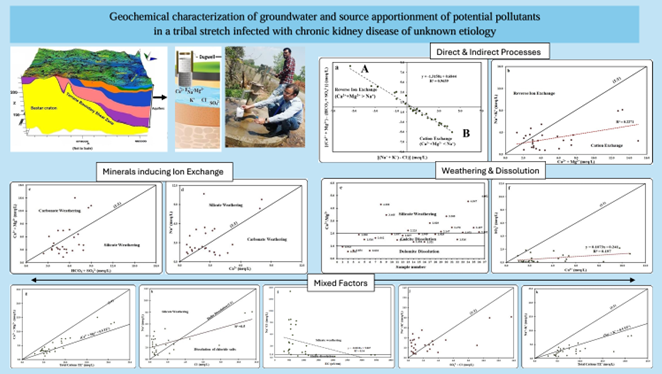
This research aimed to geochemically characterize the groundwater in Supebeda, focusing on rock–water interactions, the identification of potential pollutants, and their source apportionment using various statistical techniques. A range of hydrochemical tools—including hydrochemical interpolation and inter-ionic relationship analysis—were applied to extract the dominant geochemical signatures influencing groundwater chemistry and their sources.
Findings suggest that a combination of factors may be contributing to CKDu in the region, including:
- Elevated total hardness governed by calcium and magnesium ions,
- A high sodium-to-calcium ratio, and
- Increased fluoride concentrations.
Notably, this study represents one of the most comprehensive investigations of hydrogeochemistry in any CKDu-affected region worldwide, particularly in terms of the extent to which rock–water interactions have been explored. This makes the study a unique and globally significant contribution to understanding the environmental underpinnings of CKDu.
Please read the Full Paper here: https://doi.org/10.1016/j.chemosphere.2025.144272