- Call Us:- +91 7326070444 / +91 674 2913291
- Mon - Fri: 09.00AM to 06.00PM

Our Services

- Hydrogeological Investigations
- Hydrogeochemical Investigations
- Geophysical Investigations
- Groundwater Modelling
- Remote Sensing and GIS
- Managed Aquifer Recharge (MAR)
- Geochemical Indexing
- Human Health Risk Assessment
- Hydrological Investigations
- Sediment Transport Modelling
- Human and Climate Impact Studies
- Environmental Impact Assessment (EIA)
- Policy Design and Analysis
- Research Consultancy
- Need-based Training
Development of a water quality index for evaluation of physicochemical parameters in groundwater.
Conventionally, water quality is assessed by comparing the concentrations of physical, chemical, and biological parameters against their respective guideline values. However, when one or two parameters exceed their prescribed limits, it often becomes challenging to accept or reject a water sample based solely on this conventional approach. To resolve such dilemmas, it becomes essential to condense a large dataset into a single indicator that provides a comprehensive assessment of water quality without compromising prescribed standards.
The Water Quality Index (WQI) is a mathematical tool that integrates multiple water quality parameters into a single numerical score, indicating the suitability of a water source for drinking purposes. Horton (1965) pioneered the WQI model by assigning weights to selected parameters and combining their sub-index values using a continuous additive approach to derive a final index score. Since then, numerous WQI models have been developed worldwide, inspired by Horton’s foundational concept.
However, users of different WQI models often encounter challenges, such as: (i) varying water classifications for the same WQI model, (ii) different WQIs applied to the same dataset yielding inconsistent classifications of a single water source, and (iii) the subjective selection of a WQI model based on personal convenience.
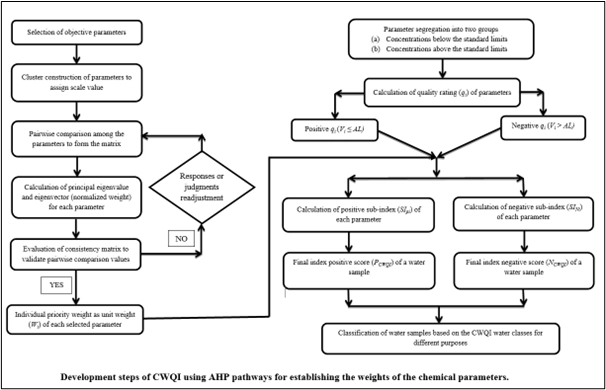
To address this confusion, a new index—Comprehensive Water Quality Index (CWQI)—was developed using the Analytical Hierarchy Process (AHP), a promising technique for assigning relative weights to parameters through pairwise comparison matrices. This method employs multi-criteria decision analysis (MCDA), incorporating geometric, division, and arithmetic operations, along with expert opinions and stakeholder inputs. As a result, it minimizes speculative errors and avoids arbitrary weight assignments.
The CWQI model incorporates unit weights and sub-index values for both relaxable parameters (which have acceptable and permissible limits) and non-relaxable parameters (which have only a single guideline value). It classifies water quality into six distinct categories, suitable for various uses. To date, CWQI is considered one of the most robust and objective indexing methods for classifying groundwater quality. It is built on logical principles and quality criteria defined by both the Bureau of Indian Standards (BIS, 2012) and the World Health Organization (WHO, 2017).
Please read the Full Paper here: https://doi.org/10.1016/j.ecolind.2022.109582