- Call Us:- +91 7326070444 / +91 674 2913291
- Mon - Fri: 09.00AM to 06.00PM
Our Services

- Hydrogeological Investigations
- Hydrogeochemical Investigations
- Geophysical Investigations
- Groundwater Modelling
- Remote Sensing and GIS
- Managed Aquifer Recharge (MAR)
- Geochemical Indexing
- Human Health Risk Assessment
- Hydrological Investigations
- Sediment Transport Modelling
- Human and Climate Impact Studies
- Environmental Impact Assessment (EIA)
- Policy Design and Analysis
- Research Consultancy
- Need-based Training
Amplification of Climate Signals Through Streamflow and Fluvial Sediment Transport along the West Coast of North America
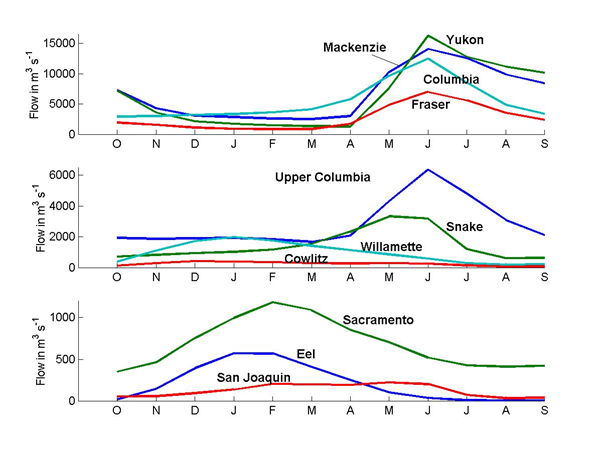
This research examines the spatial variability of streamflow and sediment discharge patterns along the West Coast of North America, with a particular focus on their relationship to large-scale atmospheric circulation indices and climate processes in the North Pacific and Arctic regions. The primary objective is to determine whether statistically significant associations exist between these hydrological patterns and large-scale climate features, and if so, to quantify the magnitude and nature of those relationships.
The atmospheric circulation patterns considered include:
- The Pacific North American (PNA) pattern,
- The Central North Pacific (CNP) pattern,
- The North Pacific (NP) pattern (all within the North Pacific mid-latitudes),
- The California Pressure Anomaly (CPA)—a regional teleconnection pattern, and
- The Arctic Oscillation (AO), representing Arctic circulation variability.
In addition, the study considers two dominant global-scale climate phenomena:
- El Niño–Southern Oscillation (ENSO), tracked using the Niño 3.4 sea surface temperature (SST) index, and
- The Pacific Decadal Oscillation (PDO).
The rivers under investigation span a north-to-south gradient and include:
- In Alaska and Canada: the Yukon, Mackenzie, and Fraser Rivers;
- In the Pacific Northwest: the Upper Columbia, Snake, Lower Columbia, Cowlitz, and Willamette Rivers;
- In California: the Eel, Sacramento, and San Joaquin Rivers.
Through this analysis, the study aims to better understand how climate signals are amplified or modulated by hydrological and fluvial sediment transport processes, thereby contributing to improved regional climate impact assessments and water resource management strategies.