Centre For Hydrological Sciences And Communication
CHSC – an R & D initiative
The primary objective of this research centre is to conduct in-depth investigations into pertinent hydrological issues and to communicate the results to the general public in simple language, ensuring that people remain aware of scientific facts. The ultimate goal is the demystification of science. It is registered under the Indian Trust Act 1882.
With a vision for nation-building, CHSC aims to assist the government in fostering a scientifically informed society. This aligns well with the country’s Vision 20301 as well as the 17 Sustainable Development Goals of the United Nations2.
Scientists predict that India will become a water-scarce country by 20503 (Fig. 1). Although such predictions are not free from uncertainties4, it is a fact that India’s population is rising steadily, and the gap between water supply and demand is widening rapidly (Fig. 2). In 1951, shortly after independence, India’s population was approximately 361 million5, and the per capita water availability was 5177 cubic metres per year3. Today, with the population soaring to about 1465 million6, this share has dropped to less than 1485 cubic metres per capita per year7. Over the next two and a half decades, the population is expected to rise to 1665 million, while per capita water availability will decline further to around 1140 cubic metres per year3. Internationally, 1700 cubic metres per capita per year is considered the minimum requirement for an individual to maintain a comfortable standard of living8–9. When availability drops below 1000 cubic metres, a country is said to have entered a state of water emergency10.
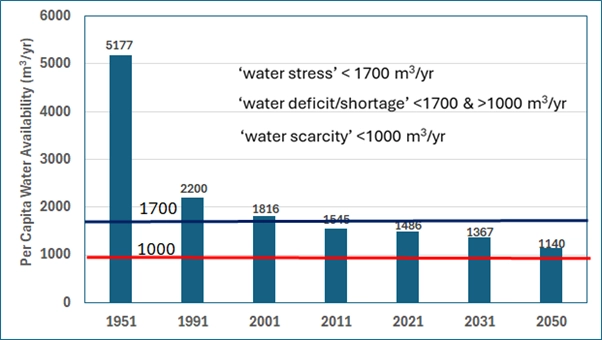
Fig. 1. Per Capita Water Availability in India – a historical perspective.
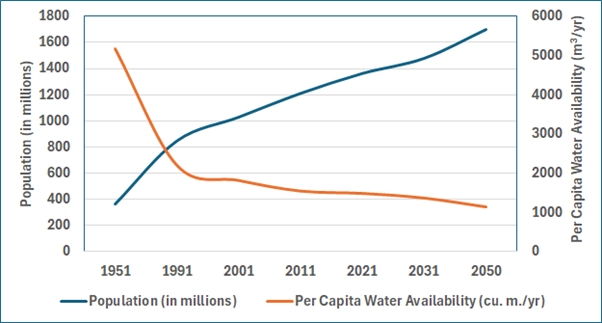
Fig. 2. Population vs. Annual Per Capita Water Availability – a historical perspective.
Numerous governmental, non-governmental, and international agencies are making efforts to avert this looming crisis, yet most of the ultimate stakeholders remain unaware of its depth and continue living as if nothing has changed. While it is true that conditions appear normal in many parts of India, such a luxury is no longer tenable in other regions where water scarcity is already a year-round issue, especially during the drier summer months. Increased public participation in water management is the need of the hour, but reaching out to the teeming millions has proven difficult. Even where awareness is spreading, the pace is too slow to inspire collective realization. This research centre firmly believes that unless every citizen understands the economic value of water and recognises their role in its conservation, India will not be able to save itself from the impending crisis.
The problem is not only quantitative. From the perspective of water quality as well, the country faces a precarious future. India is witnessing significant changes in the chemical quality of both surface and groundwater resources. Rapid urbanization and steady industrialization have led to the production of countless diversified goods, which in turn generate wastewater. This wastewater is often not treated at the source and is openly discharged into streams and rivers, further polluting an already stressed water system. The spread of contamination from toxic elements such as arsenic, fluoride, nitrate, and selenium is accelerating, rendering groundwater increasingly unfit for human consumption11. Declining groundwater levels, particularly in hard rock terrains, are further worsening the situation by exacerbating water quality degradation.
In light of these critical challenges, since 2022, CHSC has been actively engaged in multiple high-priority research projects that the country urgently requires. The ambitions are bold, and the tasks, enormous. With continued effort, it is hoped that CHSC will successfully contribute to the government’s flagship initiative: Vision India@204712.
References:
- Press Information Bureau (2019). Government unveils vision for the next decade. https://pib.gov.in/newsite/PrintRelease.aspx?relid=187925, 01 February 2019.
- United Nations (2025). Take action for the Sustainable Development Goals. https://www.un.org/sustainabledevelopment/sustainable-development-goals/
- Central Ground Water Board (2020). Master plan for artificial recharge to groundwater in India – 2020, Ministry of Water Resources, Govt. of India, 190 p. https://cgwb.gov.in/cgwbpnm/public/uploads/documents/168613326251844776file.pdf
- Stewart, T. R. (2000). Uncertainty, Judgment, and Error in Prediction. In D. Sarewitz & R. A. Pielke & R. Byerly (Eds.), Prediction: Science, Decision Making, and the Future of Nature (First ed., pp. 41-57). Washington, DC: Island Press.
- Census of India (2011). A-02: Decadal variation in population 1901-2011, India. Reference ID PC11_A02-00, Office of the Registrar General & Census Commissioner, Govt. of India. https://censusindia.gov.in/nada/index.php/catalog/43333
- World Population Review (2024). India Population 2024 (Live) https://worldpopulationreview.com/countries/india-population.
- Press Information Bureau (2024) Per capita water availability. Release ID: 2002726, 05 Feb 2024. gov.in/PressReleaseIframePage.aspx?PRID=2002726
- World Bank (2019). Helping India overcome its water woes. The World Bank. https://www.worldbank.org/en/news/feature/2019/12/09/solving-water-management-crisis-india
- Falkenmark, M., Lindh, G. (1976). Water for a Starving World. Boulder, CO: Westview Press. https://doi.org/10.4324/9780429267260
- Naik PK (2017). Water crisis in Africa: myth or reality. International Journal of Water Resources Development, 33(2): 326-339. 1080/07900627.2016.1188266
- Central Ground Water Board (2024). Ground water quality assessment – data and reports. Ministry of Jal Shakti, Govt. of India. https://cgwb.gov.in/ground-water-quality
- Government of India (2022). Consultation on Vision India@2047. https://www.mygov.in/mygov-survey/consultation-vision-india2047