- Call Us:- +91 7326070444 / +91 674 2913291
- Mon - Fri: 09.00AM to 06.00PM

Our Services

- Hydrogeological Investigations
- Hydrogeochemical Investigations
- Geophysical Investigations
- Groundwater Modelling
- Remote Sensing and GIS
- Managed Aquifer Recharge (MAR)
- Geochemical Indexing
- Human Health Risk Assessment
- Hydrological Investigations
- Sediment Transport Modelling
- Human and Climate Impact Studies
- Environmental Impact Assessment (EIA)
- Policy Design and Analysis
- Research Consultancy
- Need-based Training
Human Health Risk Assessment due to Groundwater Contamination in a Tribal Stretch in Central India: A Comparison of Probabilistic and Deterministic Approaches

A small village named Supebeda, with a population of around 1,200, located in the Gariabandh district of Chhattisgarh, India, has been silently suffering for years from an enigmatic illness known as Chronic Kidney Disease of Unknown Etiology (CKDu). The village came under national spotlight in 2018 after approximately 100 deaths and more than 300 hospitalizations were reported within a few years. Initial groundwater samples collected by the Central Ground Water Board (North Central Chhattisgarh Region, Raipur) did not indicate any serious contamination.
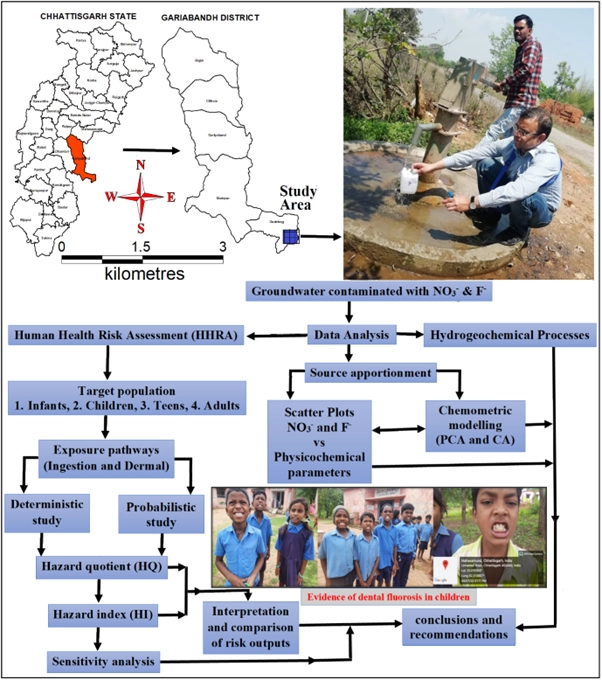
This project was undertaken to re-examine the chemical data and assess potential human health risks related to groundwater contamination in the area. Further analysis revealed the presence of nitrate and fluoride contamination in the groundwater. Accordingly, the study involved source apportionment of these contaminants and explored their relationships with other ions in groundwater. A non-carcinogenic health risk assessment was conducted across four population groups: infants, children, teenagers, and adults.
Human Health Risk Assessments (HHRA) typically employ two approaches: deterministic and probabilistic. In this study, both models were systematically applied to identify contamination pathways and quantify the extent of exposure on the local population. The results from the two approaches were compared to determine the more accurate and reliable method for risk assessment.
Findings revealed that the deterministic model tends to overestimate the hazard quotient and hazard index values, potentially exaggerating the perceived risk. This overestimation likely stems from its reliance on extreme, single-point input values for each variable, which may not reflect actual field conditions. Furthermore, the deterministic model lacks a mechanism to validate output results, making its conclusions speculative in nature.
In contrast, the probabilistic approach allows for a range of input values, enabling a more realistic representation of field conditions. It also includes sensitivity analysis, which helps validate the significance of various input variables across different exposure pathways. This flexibility and robustness make the probabilistic model a more reliable and nuanced tool for health risk assessment.
Conclusion: Given these considerations, the study concludes that probabilistic modelling is superior to deterministic approaches for assessing human health risks from groundwater contamination.
Please read the Full Paper here: https://doi.org/10.1038/s41598-023-45622-1