- Call Us:- +91 7326070444 / +91 674 2913291
- Mon - Fri: 09.00AM to 06.00PM

Our Services

- Hydrogeological Investigations
- Hydrogeochemical Investigations
- Geophysical Investigations
- Groundwater Modelling
- Remote Sensing and GIS
- Managed Aquifer Recharge (MAR)
- Geochemical Indexing
- Human Health Risk Assessment
- Hydrological Investigations
- Sediment Transport Modelling
- Human and Climate Impact Studies
- Environmental Impact Assessment (EIA)
- Policy Design and Analysis
- Research Consultancy
- Need-based Training
Hydrogeochemical Forecasting in a Tribal Stretch infected with Chronic Kidney Disease of Unknown Etiology (CKDu)
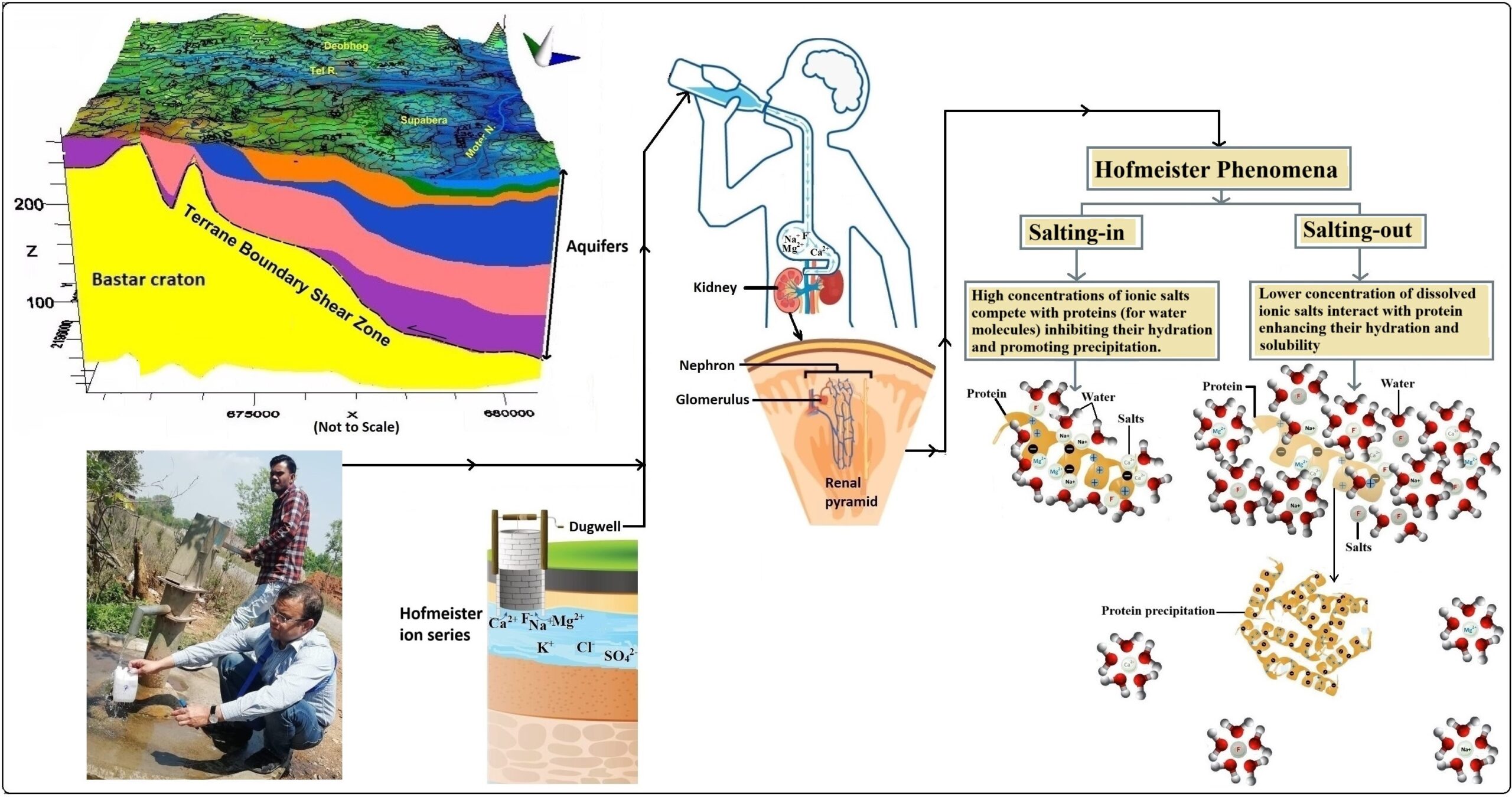
This project is a continuation of two earlier studies conducted in the CKDu-infected Supebeda region of Chhattisgarh, located in the tribal district of Gariabandh in central India. One of the previous studies assessed the human health risks due to fluoride and nitrate contamination in groundwater, while the other carried out a detailed geochemical characterization of the region. That study highlighted significant rock–water interactions, conducted source apportionment of potential pollutants, and hypothesized that a combination of elevated total hardness (governed by calcium and magnesium ions), a high sodium-to-calcium ratio, and increased fluoride levels could be the inducing factors for CKDu in the area.
The present study focuses on forecasting the region’s future geochemical environment using saturation indices of several key minerals. It also introduces a probabilistic estimation of the population’s exposure to ions in the Hofmeister series, aiming to explore the specific ion effects that may contribute to the onset of CKDu—an area rarely explored in environmental health studies.
The Hofmeister ion series categorizes ions based on their influence on the chemical properties of aqueous solutions, particularly via their activity coefficients. The solubility, precipitation, and complexation behavior of compounds, especially proteins, are strongly governed by these specific ion effects. First observed by Hofmeister (1888) and his student Lewith (1887), the series was established through experiments on how different ions affect protein solubility. These processes—known as “salting-in” and “salting-out”—have wide-reaching implications in biogeochemistry and are particularly relevant in the renal tubular environment.
- In salting-in, low salt concentrations increase protein solubility by shielding charges on the protein surface, thereby reducing aggregation.
- In salting-out, high salt concentrations reduce protein solubility as ions compete with proteins for water molecules, leading to protein precipitation.
Given that chronic kidney diseases are closely linked to protein metabolism, this study uniquely attempts a probabilistic estimation of the population’s exposure to Hofmeister ions through groundwater ingestion—an innovative analytical approach not previously applied in CKDu research.
Key findings from the study include:
- The saturation indices of minerals such as fluorite, anhydrite, gypsum, halite, and sylvite indicate undersaturation, suggesting that further dissolution of these minerals is likely. This would increase the concentrations of fluoride, calcium, sodium, potassium, sulphate, and chloride ions in the groundwater.
- Probabilistic human health risk assessment revealed that the 95th percentile of average daily dose (ADD) values for calcium, magnesium, sodium, and fluoride significantly exceed their respective Hofmeister threshold levels.
- These ions are implicated in salting-in and salting-out processes within the kidneys and may lead to protein precipitation, thereby contributing to the development of CKDu due to their excessive bioavailability.
Conclusion: This study offers a novel hydrogeochemical forecasting model supported by the Hofmeister ion framework, providing a unique and scientifically robust explanation for groundwater-induced CKDu in Supebeda. It marks the first known attempt to link Hofmeister phenomena with environmental exposure and kidney disease progression in a real-world context.
Please read the Full Paper here: https://doi.org/10.1016/j.scitotenv.2025.178906